Recently, I got to work on a script with PBS Spacetime on Constructor Theory. This topic was particularly unique as it didn’t deal extensively with physics but focused on the framework with which we approached and developed physical theories about our reality.
The question: Will Constructor Theory Rewrite Physics?
How Are Theories Made?
For starters, how do we come up with our theories? Well, physics advocates a systematic approach where we begin by recording our observations of reality in terms of numbers. We then formulate an equation that governs these numbers, and describes their behavior with respect to time. This way, when we are given an initial set of numbers describing a system at a moment in time, we are able to use the equations to predict the system and its behavior at a future moment in time.
Ancient civilizations followed this approach to the tee and while they may not have always been able to formulate an overall theory to describe a given phenomenon, they were adept in observing numerical patterns as a means towards an end. A simple example would be the tracking of planetary and stellar motion across the sky to keep track of the seasons that are most profitable for agriculture.

Much like a mathematical function, physics works by taking an input state and applying a dynamical law (the function) to it to predict an output state. When the predictions made by the law matches reality it is deemed to be true. When it does not, changes have to be made, and we are back at the drawing board. There are a lot of equations in physics, each describing a certain aspect of our reality. What if all these equations were brought together under one theory, one theory to rule them all, a theory of everything. Right now, we can derive everything there is related to theories on thermodynamics, mechanics, electricity and magnetism, etc. These theories branch out from two master theories: quantum mechanics and Einstein’s theory of relativity. But is there a grand master theory that unifies the latter two?
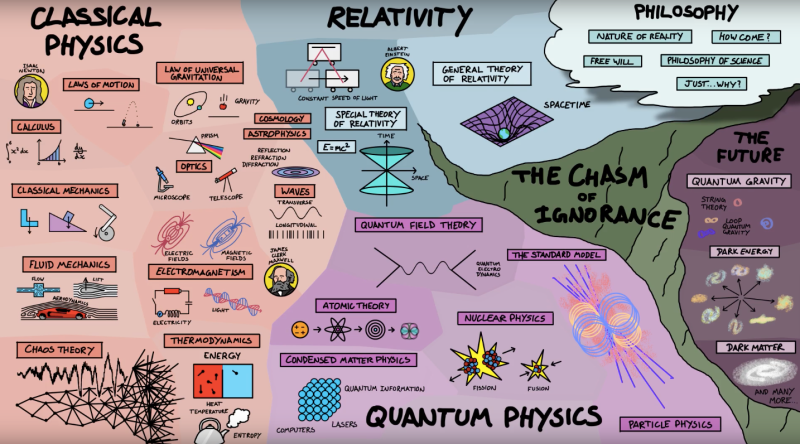
For many years, the greatest and most creative minds have failed in the quest to discover a grand master theory. Enter David Deutsch and Chiara Marletto at Oxford University who claim that a new approach in how we do physics at the fundamental level, through constructor theory, might make all the difference to finding success in this quest.

A New Approach In Constructor Theory
In constructor theory, we don’t look at the mathematical description of how something occurs. Rather, we look at whether or not a particular process is possible.
Constructor theory is a theory of possibilities. We look at transformations that occur in a system, allowing it to evolve from an initial input state to a final output state. Constructor theory rules out all the impossible output states given the initial input state of the system using existing master theories of quantum mechanics and relativity.
In this framework, the transformations that take a system from input to output state are called tasks. If a particular task is possible, then there is a constructor that can perform the task. Inspired by information theory and quantum computing, constructor theory reframes reality in terms of constructors that influence tasks. Our focus here is on if the given task is possible or impossible for a given constructor. This may not sound new but it really does provide a change in perspective regarding how we approach a problem. Let’s consider a simple example.
Imagine I drop a ball from the top of a building. Using Newton’s laws and his equations of motion I can define the position of the ball at any point in its fall, the exact time it reaches the ground, etc.

Einstein’s theory of relativity refines this view and describes the ball as not falling due to a force known as gravity but rather following a straight line across curved spacetime, a geodesic.
Constructor theory pushes aside this mechanistic approach, and instead focuses on looking at the physics without solving all the detailed equations. This way, we are able to make general statements about how the ball can behave. It is not possible for the ball to suddenly just hover in the air. Relativity forbids this. The ball can’t just disappear either. Quantum mechanics and conservation of energy forbid this. The only task that is possible for the ball at the moment it is dropped from the top of the building is to fall to the floor and reach the ground. This is its one and only output state. A much more specific statement that dwindles down other false deductions.
At first, this may not seem like anything new, but constructor theory helps formalize our observations of a particular system into a mathematics of possibility. This is powerful and allows the theory to even be applied in situations where we may not know the laws or have a fully-formulated mechanistic theory.
Construction Time
As Chiara Marletto puts it, constructor theory brings forth a science of can and can’t.

I find the theory to be unique as it adds an epistemological, ergo a philosophical, framework to our approach in devising physical theories to describe our universe. In a day and age where philosophy is often set aside in place of science, constructor theory brings fresh perspective and demonstrates how philosophical notions of deduction and logic continue to temper, guide, and initiate new perspectives in science.
While it remains to be seen if constructor theory is successful in achieving its lofty claims, we cannot underestimate the possibility of future developments, seeing that many foundational theories in physics began with a cautious and reluctant audience.

 The Procrastinating Scientist